If you’ve spent any time around game development forums, product design teams, or even indie creators over the last year, you’ve probably noticed something: 3D content creation is no longer reserved for specialists with years of modeling experience.
That shift didn’t happen quietly—and it didn’t happen by accident.
At the center of it is 3dm ai, a term that’s quickly becoming shorthand for AI-assisted 3D modeling workflows that radically reduce the time, cost, and skill barrier traditionally associated with 3D assets.
For years, creating usable 3D models meant mastering complex tools, understanding topology, UV mapping, and spending hours refining geometry that most end users never notice. Today, teams are generating concept-ready and even production-ready models in minutes—not weeks.
This guide exists for a specific reason: most articles about 3dm ai are either hype-driven or painfully shallow. They tell you what it is, but not how it fits into real work, where it breaks, or when it’s actually worth using.
If you’re:
- A creator tired of bottlenecks
- A founder trying to ship faster
- A designer stretched beyond your skillset
- Or a developer who just needs usable 3D assets without drama
This article will give you clarity, not buzzwords.
By the end, you’ll understand not just what 3dm ai is—but how to use it intelligently, avoid common traps, and decide whether it belongs in your workflow at all.
What Is 3dm ai? (Explained Without the Hype)
At its core, 3dm ai refers to the use of artificial intelligence to generate, enhance, or modify 3D models—either from text prompts, 2D images, scans, or partial geometry.
The easiest way to understand it is to compare it to the evolution of photography.
Traditional 3D modeling is like shooting on manual film cameras: powerful, precise, but slow and unforgiving. AI-driven 3D modeling is closer to modern smartphone photography—it handles the heavy lifting so you can focus on intent rather than mechanics.
But here’s where most explanations fall apart: 3dm ai doesn’t replace 3D modeling—it compresses it.
Instead of manually:
- Blocking geometry
- Refining topology
- Baking details
- Re-doing iterations
You guide the system with:
- Descriptions
- References
- Constraints
- Post-generation edits
Behind the scenes, models trained on millions of 3D shapes, textures, and spatial relationships predict what a “chair,” “character,” or “mechanical part” should look like in 3D space.
Importantly, modern 3dm ai systems are not single-purpose tools. They’re ecosystems that may include:
- Text-to-3D generation
- Image-to-3D reconstruction
- AI retopology
- Texture synthesis
- Mesh optimization
For beginners, that means speed.
For professionals, that means leverage.
Why 3dm ai Is Gaining Traction Across Industries
The reason 3dm ai adoption is accelerating isn’t novelty—it’s economics.
Before 3dm ai
- 3D assets took days or weeks
- Skilled labor was expensive
- Iteration cycles were slow
- Prototyping was gated by specialists
After 3dm ai
- First drafts appear in minutes
- Non-experts can create usable models
- Iterations are cheap and fast
- Visual ideas move earlier in the pipeline
This shift is showing up everywhere:
Game development:
Indie teams generate placeholder assets instantly, then refine only what ships.
E-commerce:
Brands produce hundreds of product models without physical scans.
Architecture & real estate:
Early-stage visualizations are created before CAD precision is needed.
AR/VR & metaverse projects:
Rapid world-building becomes viable without massive art teams.
The real value isn’t that AI creates “perfect” models—it creates good-enough starting points that unblock momentum.
Real-World Benefits and Use Cases of 3dm ai
Here’s where experience matters. In practice, 3dm ai shines in very specific scenarios—and struggles in others.
Where 3dm ai Excels
1. Concept modeling
Need to visualize an idea fast? AI models are ideal for early exploration.
2. Rapid prototyping
Product teams can test form factors before committing to engineering.
3. Background and secondary assets
Not every model needs artisan-level detail.
4. Iteration speed
Changing proportions or styles becomes trivial.
Where It Still Falls Short
1. Precision manufacturing
AI struggles with strict tolerances and mechanical constraints.
2. Animation-ready topology
Generated meshes often need cleanup.
3. Highly stylized art direction
Consistency across characters or assets requires human control.
The sweet spot is using 3dm ai as an accelerator—not a replacement.
A Step-by-Step Practical Workflow Using 3dm ai
This is the part most articles skip. Here’s a realistic workflow that actually works.
Step 1: Define Intent (Not Just Prompts)
Before touching any tool, clarify:
- Is this a concept or final asset?
- What level of detail is required?
- Will it be animated, printed, or rendered?
AI performs best when constraints are clear.
Step 2: Choose Input Type
Most 3dm ai systems support:
- Text prompts (fastest)
- Image references (more control)
- Hybrid workflows (best results)
Experienced users often combine rough sketches with prompts for better outputs.
Step 3: Generate Multiple Variations
Never settle for the first output. Generate variations and compare:
- Proportions
- Surface detail
- Mesh density
Think of this like creative brainstorming—not final selection.
Step 4: Clean and Optimize
This is where professionals separate from amateurs:
- Retopologize if needed
- Reduce polycount
- Fix normals and artifacts
AI gets you 70% there. The last 30% still matters.
Step 5: Integrate into Your Pipeline
Export formats typically include:
- OBJ
- FBX
- GLTF
From there, assets move into game engines, renderers, or CAD tools.
Tools, Platforms, and Expert Recommendations

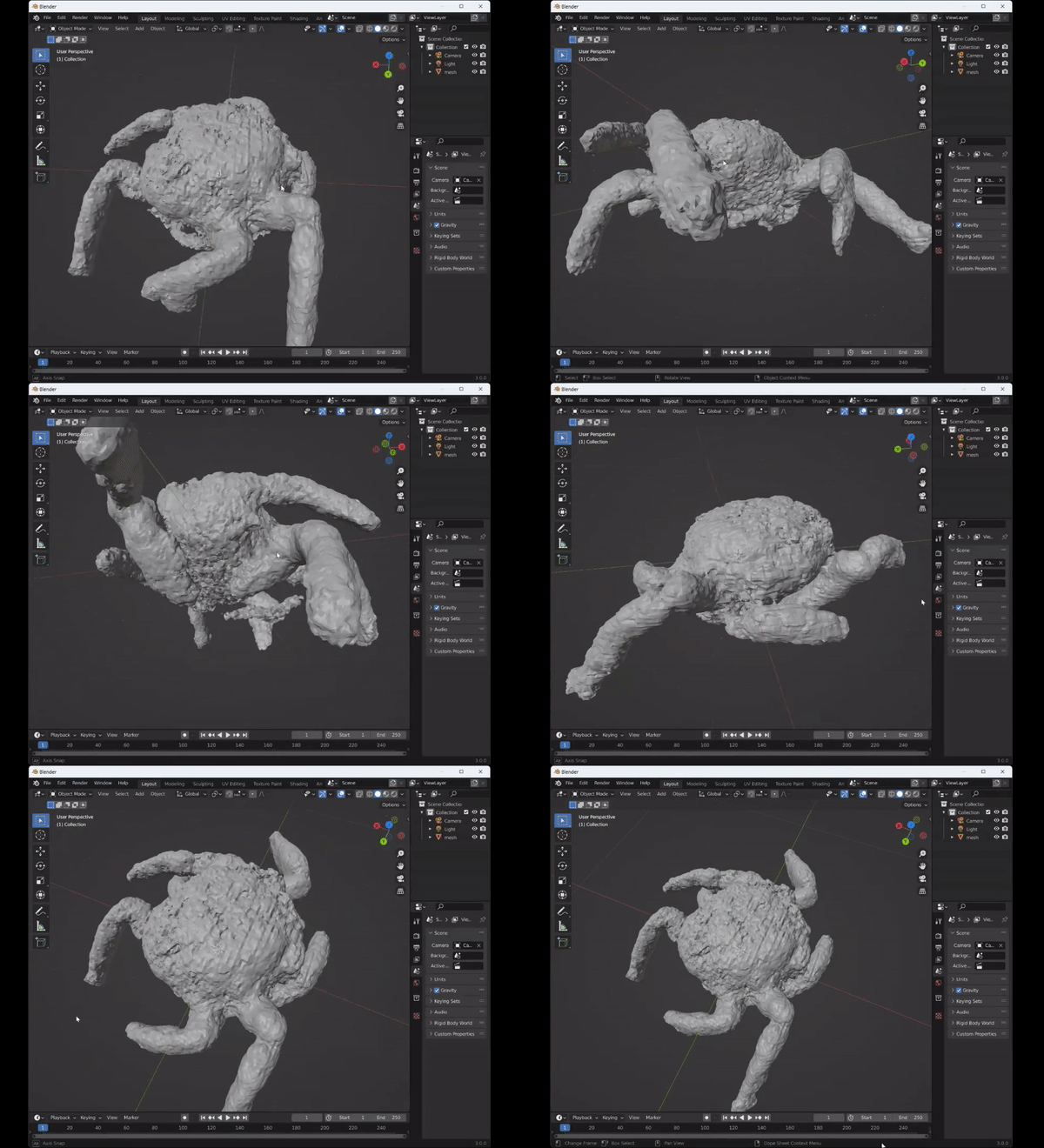

The 3dm ai landscape changes fast, but usage patterns remain consistent.
Beginner-Friendly Tools
- Text-to-3D platforms for fast concepts
- Minimal settings
- Limited customization
Best for ideation and non-technical users.
Professional-Grade Platforms
- Hybrid AI + manual workflows
- Retopology controls
- Export flexibility
This is where teams build reliable pipelines.
Free vs Paid Reality Check
Free tools are excellent for testing, but paid platforms:
- Offer higher resolution meshes
- Provide commercial licenses
- Support batch workflows
In practice, most professionals use multiple tools depending on the task.
Common 3dm ai Mistakes (And How to Avoid Them)
This section comes straight from real usage.
Mistake 1: Expecting production-ready assets
Fix: Treat AI output as a starting point.
Mistake 2: Ignoring topology quality
Fix: Always inspect meshes before use.
Mistake 3: Over-prompting
Fix: Simple, clear prompts outperform verbose ones.
Mistake 4: Skipping manual refinement
Fix: Human judgment still defines quality.
Mistake 5: Licensing blind spots
Fix: Always verify commercial usage rights.
The Future of 3dm ai (What’s Actually Coming)
Short term:
- Better topology awareness
- Improved texture realism
- Faster generation
Mid term:
- Constraint-based modeling
- Style consistency across assets
- Real-time iteration
Long term:
- AI-native 3D pipelines
- Integrated physics and materials
- Human-AI co-creation as the default
The winners won’t be those who “use AI”—but those who understand where and why to use it.
Conclusion: Is 3dm ai Worth It?
If you need perfect craftsmanship from frame one—no.
If you need speed, flexibility, and creative momentum—absolutely.
3dm ai is not about replacing expertise. It’s about multiplying it.
Used thoughtfully, it removes friction, unlocks experimentation, and allows small teams to compete with large ones. Ignore it, and you’ll increasingly find yourself slower—not because you lack skill, but because others are shipping faster.
The smartest move isn’t adoption or rejection.
It’s integration with intent.
FAQs
It generally refers to AI-assisted 3D modeling workflows and tools.
Yes—especially for concept creation and learning fundamentals.
It depends on the tool’s license. Always check usage rights.
No—it complements them.
Visually strong, technically variable.